
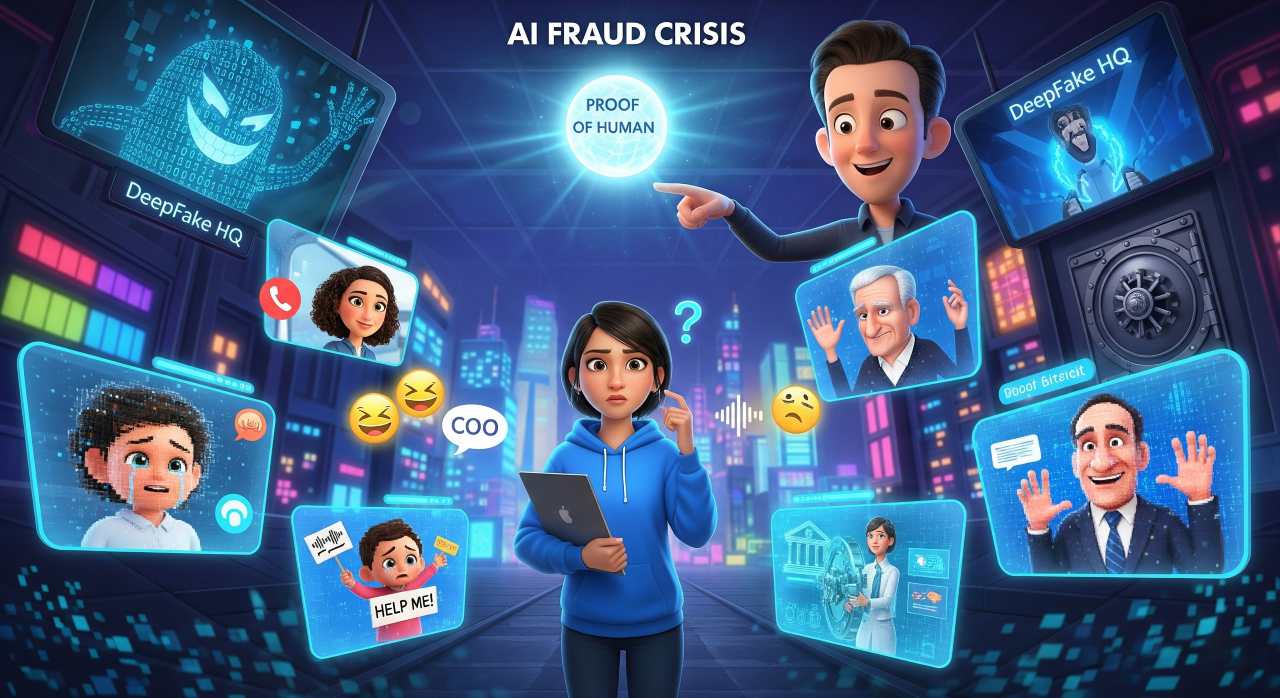
It’s not a sci-fi plot — it’s reality. Sam Altman, CEO of OpenAI, is sounding the alarm on what he calls an incoming “AI fraud crisis.” Speaking at the Federal Reserve, Altman painted a future that’s already creeping in: cloned voices, fake video calls, and digital impersonations so real. You might not know who you’re actually talking to. And yes, this goes way beyond prank calls — we’re talking financial fraud, misinformation warfare, and threats to national security.
Altman’s warning comes as OpenAI pushes deeper into Washington politics, setting up a new D.C. office to guide AI policy. At the same time, ChatGPT’s influence continues to skyrocket, with over 500 million users and growing economic implications. For Gen-Z, already raised in a digital-first world, these developments are both thrilling and terrifying. The question isn’t just “What can AI do?” — it’s “Who’s in control, and how do we keep it safe?”
OpenAI’s Push Into Washington Signals Urgency
As the AI landscape shifts at warp speed, OpenAI is positioning itself not just as a tech pioneer but as a key player in U.S. policy. This month, the company announced it will open its first Washington, D.C. office, a move that reflects growing concern over the social and economic impacts of AI. Chan Park, OpenAI’s head of global affairs, and Joe Larson, a former Anduril executive, will lead the 30-person team — bridging the gap between innovation and regulation.
This physical foothold in the capital gives OpenAI direct access to lawmakers and policymakers, where it hopes to shape decisions on everything from AI safety standards to global competitiveness. Training sessions, tech previews, and collaborative research into AI’s economic effects will also be hosted in the new space. And while Altman is pushing for responsible AI use, OpenAI has also urged caution against over-regulation, warning that excessive constraints could let countries like China gain an edge.
The Fraud Crisis Has Already Begun
Altman isn’t forecasting a future problem — he’s describing one that’s already here. From deepfake voice scams to video impersonations, the misuse of AI is rising fast. The FBI has already issued warnings about AI-generated calls mimicking loved ones or public figures to manipulate people into handing over money or sensitive information. In one recent incident, someone used AI to fake the voice of Secretary of State Marco Rubio, targeting international leaders and government officials.
For Altman, the scariest part isn’t just what AI can do — it’s how unprepared we are. Many banks still use voice authentication systems that can now be spoofed with frightening ease. In his talk, he emphasized the looming threat of video forgeries becoming indistinguishable from reality. His proposed fix? Tools like The Orb, created by Tools for Humanity, which aim to verify whether a user is human in an increasingly AI-saturated internet. Bottom line: digital trust is breaking — fast.
The AI Fraud Crisis Could Threaten More Than Your Bank Account
The phrase AI fraud crisis might conjure up hacked phones and shady emails, but Altman warns the stakes are much, much higher. In an era where ChatGPT and other models can simulate entire conversations, generate convincing fake content, and even write code, the threat extends to national security. Imagine an AI-generated email convincing a utility company to shut down part of the power grid — it’s not sci-fi anymore.
OpenAI’s CEO also revealed what truly keeps him up at night: the risk of an AI superintelligence falling into the wrong hands. Think bioweapon designs or destabilizing cyberattacks launched by adversarial nations. It’s not just about tech misuse — it’s about geopolitical risk. The U.S. can’t afford to fall behind in the AI arms race. Altman’s frank concerns echo rising fears in the White House, where the forthcoming “AI Action Plan” aims to secure America’s dominance while acknowledging the dangers lurking beneath innovation.
What Jobs Look Like in an AI-Powered Future
While some CEOs panic about mass unemployment, Altman remains surprisingly calm — or at least uncertain. “No one knows what happens next,” he told the Fed audience, pushing back against Silicon Valley’s gloomy predictions. Yes, some job classes will vanish. But new forms of work will rise too — maybe even ones we can’t define yet. Altman believes that, 100 years from now, the concept of a “real job” may feel outdated entirely.
In OpenAI’s own report, Chief Economist Ronnie Chatterji compared ChatGPT’s impact to electricity and the transistor. With 500 million users and counting, ChatGPT is already transforming the way we work. In the U.S., 20% of users rely on it as a “personal tutor,” and over half of them are under 35 — a sign that Gen-Z is integrating AI into their workflows faster than any generation before. What’s next? Altman hints at a future where fulfillment might come from making up jobs — not doing them.
One reply on “How OpenAI Sees the AI Fraud Crisis Taking Shape”
Linktree Cryptozink11
KRIPTO11
Green Screen Things